| Article number: | 232 |
| Availability: | In stock (22) |
| Delivery time: | NL and BE 1-2 days - Rest of Europe 2-8 days |
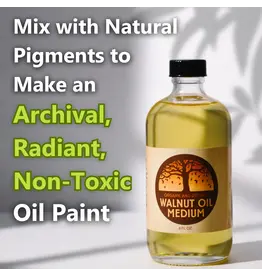
If you are using mineral pigments frequently, the bulk packages of all colors might be an economical option for you! The biodegradable bags are filled with ca. 450 grams of natural oil pigments! Complete your pigments with the refined and oganic walnut oil. You can mix as much as you need and walnutoil in contrast to linseed oil doesn't yellow overtime. Our mineral pigments can be used for natural oil paint, our natural acrylic paint and with water. When using the mineral pigments with water, it can be nice to add arabic gum(also available from us) to make the pigments bind better with water.
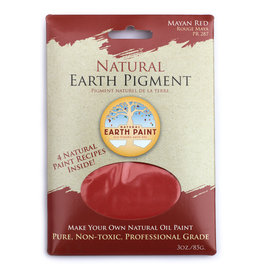
Note: not all colours have the same weight. Mineral pigments are natural and do differ in weight and consistancy. Therefore our bags are filled with a volume which will be enough to make at least 500 ml to 1 liter of oil paint. The volume of this Mayan pigments is 3 times that of other colours for the weight. So it seems like the price is much higher but you're actually getting 3x more pigment.
About the color Mayan Red:
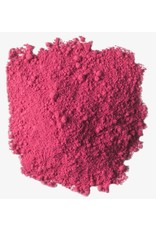
Color Index # PR 287 - A beautiful, vibrant, bright red. After 4 years of searching for a completely non-toxic, natural and professional grade bright red, she's finally arrived! When mixed is very close to Alizarin Crimson. Makes beautiful, bright pinks when mixed with white. Composed of a natural earth clay base with botanical, organic dyes affixed to it.
Lightfastness- Excellent
Can't find the answer to your question below? Check out our FAQ-page, here you can also find frequently asked questions about specific color pigments.
Are your pigments cosmetic grade?
Our pigments are not certified cosmetic grade. Our pigment providers have said that they are safe for cosmetics, but they are not technically certified cosmetic-grade. We use certified cosmetic grade pigments for our natural face paint but we don't sell those pigments.
What do I mix with your pigments to make paint? Water, binders, etc.
It depends on what type of paint you are trying to make. Our “Recipes” and "tips & tricks" section is full of useful information and recipes for making a wide variety of paints. Water alone does not work - it will appear to make a creamy paint but when it dries it will dust off the surface. You need to add a natural binder to make it adhere to a surface. Here are a few of the most popular recipes: Oil Paint, Watercolor Paint, Acrylic Paint, Gouache Paint, Egg Tempera Paint, Drawing Ink
Are the pigments and paints archival and lightfast?
Yes, all our Earth and Mineral Pigments and paints are extremely archival and have excellent/ permanent lightfastness. Natural earth pigments are the most permanent and archival of any pigment and don’t contain fillers, stabilizers, solvents or preservatives. The earth pigments will last thousands of years in a glass jar and never fade or degrade. Without the fillers and additives, nothing gets in the way of the purity and longevity of these paints.
Do I need to wear a mask when mixing powders?
Our pigments are completely non-toxic but no matter what kind-of dust you're using, you don't want to inhale large amounts of any kind. Most artists who mix our pigments don't wear any mask protection because they scoop small amounts and mix carefully so as to not create any airborne dust. But definitely use a mask if you have lung sensitivity or health problems or are concerned in any way.
How much pigment do I need to add? What is the ratio of pigment to oil when mixing oil paint?
Every color has a completely different oil:pigment ratio because each color absorbs moisture differently and each pigment has a different molecular structure, size, density, drying time, etc. You simply pour the pigment onto the palette and add small amounts of oil at a time and mix until it makes a smooth, thick paste. You can use a glass dropper to add drops at a time.
Why should I mix my own paint when I can buy paint pre-made?
We believe that the extra step of mixing your own paint is well worth the peace of mind of knowing you are using the safest and most sustainable paint on the market. Our Natural Earth Paint for children contains only three natural ingredients, and the Earth & Mineral Pigments contain only one ingredient. Most pre-made paints on the market contain a variety of toxic chemical stabilizers, petrochemicals, fillers, and preservatives. Natural pigments provide an unsurpassed luminosity, depth of color, UV resistance, humidity resistance, and archival qualities. As soon as you have a liquid paint you need a preservative to keep it from going bad on the shelf - by mixing your own, there's no need for preservatives. Conventional paints are the "fast food" approach that the mainstream paint industry thinks consumers demand, but we believe our customers deserve better.
Where do your pigments come from?
We get our pigments from small quarries in countries across the world, including the USA, France, and Italy, depending on where that color pigment is prevalent in the ground. We manufacture our paints in Ashland, Oregon.
Can I use your pigments to color wax or encaustics?
People commonly use our pigments with wax and encaustics. Anything that you would use regular pigments with you can use our natural pigments as well. They are color stable to heats from 330 degrees to 1100 degrees depending on the color.
Can I use your pigments for modeling clay?
Yes, our natural pigments are safe to use in modeling clay. Be sure to not use the Natural Earth Paint, only pure pigments. We also have a recipe for making natural modeling clay.
Titanium White - does it contain titanium dioxide?
Our Titanium Dioxide (Ti02) is from a common mineral found in nature called Rutile. It is found in metamorphic and igneous rocks, and is the second most abundant mineral sand. Our product is not to be confused with Titanium metal (Ti) which is a silver metal that can also be derived from the same deposits but is a different, separate component. Titanium metal is not a part of our Titanium White pigment. Titanium Dioxide White is a byproduct of oxidizing the rutile mineral and does not contain any metal. The only other natural white would be chalk whiting; however, this does not have the opacity or refractive index of Titanium White so it is not really a substitute. Please note, Titanium dioxide is toxic to breathe in large amounts because it contains silica (ground quartz) which is abrasive to the lungs. We have warnings on our product boxes but please be careful to mix with care so as not to inhale the dust. Once the pigment is in liquid form it is completely harmless and is commonly in natural sunscreens, food and vegan milks.
Does your Titanium White paint yellow over time?
If your white paint is yellowing, it’s actually the oil that’s turning it yellow, not the pigment itself. Some painters mix Liquid Gold Hempseed Oil or poppyseed oil (since it is the clearest of all oils) with their white pigments only instead of walnut or linseed oil, to stop it from yellowing. Many artists do that for just white. We carry walnut oil because it is less yellowing than linseed oil although linseed oil dries faster which some people prefer.
Where do you find the Ultramarine Blue and Ultramarine Purple pigments?
The blue and purple pigments are our only pigments that have been fired and manipulated to get their vibrant color. Each is composed of 90% natural earthen clay and 10% man-made minerals (which are heated in an oven to a high temperature to create their vibrant color.) Throughout history, blues in nature were very rare and usually made with precious stones like Lapis Lazuli. These stones are now unsustainably harvested in Afghanistan, so we have found a beautiful and eco-friendly alternative.